

Marketers and healthcare business owners have well and truly jumped on the AI train. And for good reason. Generative AI tools are helping teams produce content faster, streamline communication, automate repetitive tasks and dramatically increase output. For stretched marketing teams, the efficiency gains are real and immediate.
But here is the question every healthcare organisation should be asking: if every organisation and every marketer starts using large language models such as ChatGPT and Claude to generate their content, where is the strategic advantage?
When everyone draws from the same tools, prompted in similar ways, the output starts to converge. The market fills with content that sounds competent, reads smoothly and says almost exactly what everyone else is saying. Efficiency alone does not win market share. Differentiation does.
In this article, we explore how AI is reshaping digital healthcare marketing, the genuine opportunities it creates, and the commercial risks healthcare organisations must manage if they want AI to strengthen their market position rather than erode it.
The Opportunities: Where AI Genuinely Adds Value
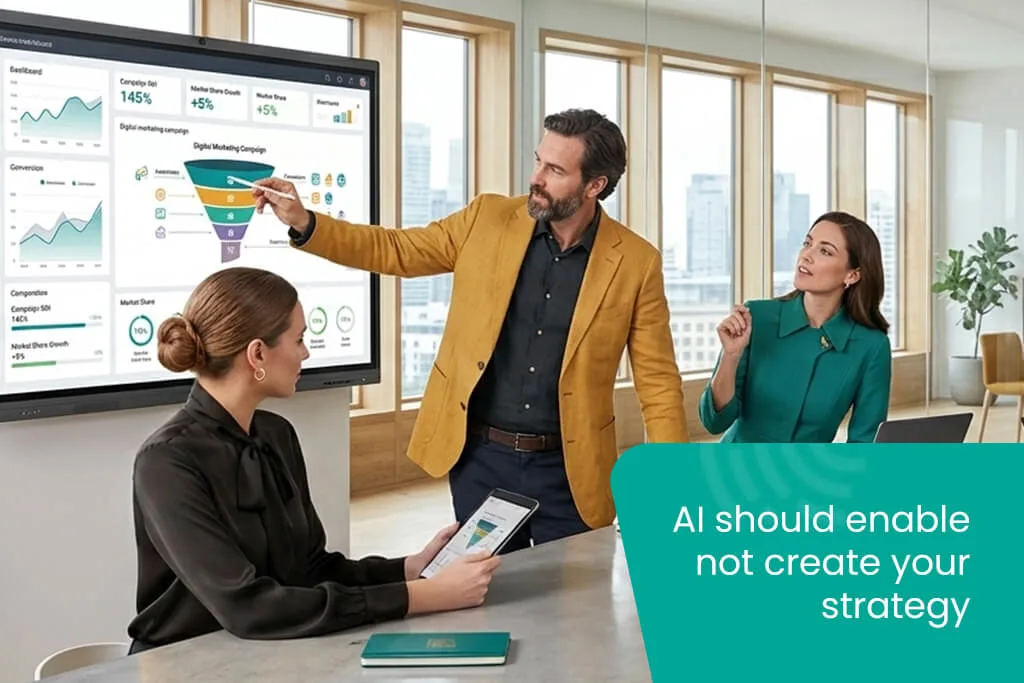
Used well, AI is a powerful addition to healthcare digital marketing solutions. The organisations getting the most from it are using AI to amplify strong strategy – not to substitute for it.
Greater efficiency and economies of scale
AI can automate repetitive tasks such as email workflows, social media scheduling, lead nurturing, reporting and first-draft content production. Marketing teams execute faster, produce more and free up time for the strategic work that actually moves the needle.
Smarter content production
AI tools can accelerate content outlines, keyword research, content repurposing and search optimisation. For healthcare organisations producing educational content across multiple channels, this significantly reduces production time – provided expert review remains part of the process to protect accuracy and compliance.
Sharper audience insights
Healthcare organisations collect large volumes of data across websites, CRM systems, social platforms and campaigns. AI can analyse this information quickly, improving audience segmentation, campaign forecasting and resource allocation.
Stronger patient and customer engagement
Intelligent chatbots, automated communication and personalised website experiences help healthcare organisations respond to patients, clinicians and buyers with relevant information at the right moment – around the clock.
These are real benefits. But they are table stakes. Every one of your competitors has access to exactly the same tools. Which brings us to the risks that matter commercially.
The Risks: What AI Overreliance Costs Healthcare Brands
Risk 1: Loss of competitive advantage
Generative AI produces content based on patterns in existing information. When your competitors use the same models, the same prompts and the same generic best practice, the output converges. Positioning blurs. Messaging becomes interchangeable. The distinct expertise, perspective and value proposition that set your organisation apart get flattened into the industry average.
In competitive healthcare markets – where differentiation is often the deciding factor for clinicians, procurement teams and patients – sounding like everyone else is a commercial liability, not a cost saving.
Risk 2: Audience disengagement
Healthcare audiences are discerning. Clinicians, healthcare professionals and increasingly patients can spot content that looks and feels AI-generated: the formulaic structures, the generic phrasing, the absence of genuine clinical or commercial insight.
When audiences sense that content was mass-produced rather than written with real understanding of their world, engagement drops – and so does trust. In healthcare, where credibility is the currency of every relationship, that is a serious problem. Content that fails to demonstrate authentic expertise does not just underperform. It actively signals that your organisation has nothing distinctive to say.
Risk 3: Declining search visibility
Search engines are evolving in direct response to the flood of AI-generated content. Google’s ranking systems increasingly reward original, experience-led, people-first content that demonstrates genuine expertise, authoritativeness and trust – and demote scaled, low-value content produced primarily to fill search results.
Organisations publishing high volumes of lightly edited AI content risk watching their search visibility erode over time, while competitors investing in original insight, real expertise and human-authored perspective strengthen theirs. The same dynamic is emerging in AI-powered search and answer engines, which favour credible, authoritative sources when generating responses.
Risk 4: Accuracy, compliance and credibility
In healthcare, the stakes of getting content wrong are higher than in almost any other industry. AI systems can generate inaccurate, outdated or misleading information – and in a regulated environment, that creates both compliance exposure and brand damage. Human oversight by people who understand healthcare communication is not optional. It is the safeguard that protects your credibility.
The Real Divide: AI as Replacement vs AI as Multiplier
The most important strategic decision healthcare organisations will make about AI is not which tool to use. It is what role AI plays in the team.
“Businesses that strip senior, knowledgeable strategic marketers from their teams and replace them with AI-generated content and strategies will fall behind. The competitors who win will be the ones who realise AI is not there to replace those people – it’s there to take their commercial excellence to greater scale and reach, and use that to take market share.”
– Kate Leeson, Healthtech Marketing Solutions

This is the divide that will separate healthcare brands over the next few years. On one side: organisations that treat AI as a cost-cutting substitute for strategic expertise, producing more content with less insight. On the other: organisations that pair experienced strategic marketers with AI’s efficiency – using the technology to extend the reach and scale of genuinely strong thinking.
One group gets cheaper marketing. The other gets market share.
The Winning Formula: Strategy at Scale
If you want to leverage AI to build a stronger position in your market, the Healthtech Marketing Solutions team can help. We combine the efficiencies and economies of scale that AI digital marketing tools deliver with the high-quality, strategic, healthcare-informed approach that generic AI output cannot replicate – a winning formula designed to outpace competitors who rely too heavily on AI generation alone.
Healthcare marketing is all we do. We understand your audiences, your buying journeys and the trust your market demands – and we know how to put AI to work in service of that strategy, not in place of it.
Let’s build a healthcare marketing strategy that works harder for your business. Contact Healthtech Marketing Solutions to book a consultation.