
AI is changing the way websites are planned, written, designed and optimised. For healthcare organisations, this creates a major opportunity.
AI can help teams move faster. It can support keyword research, content planning, user journey mapping, technical checks, search optimisation and even first-draft copywriting. But in healthcare, speed should never come at the expense of accuracy, trust, compliance or patient safety.
A healthcare website is the first place a patient, clinician, procurement team, investor or referral partner goes to understand who you are, what you offer, and whether they can trust you.
So the real question is not: should healthcare companies use AI when building websites?
The better question is: how can AI be used responsibly, strategically and effectively, while still keeping healthcare expertise at the centre?
Why healthcare websites are different
Healthcare websites carry a level of responsibility that many other industries do not.
A website for a medical device company, pharmaceutical brand, health service provider, clinic, digital health platform or medical cannabis business needs to do more than look professional. It needs to communicate clearly, support the right audience, and avoid creating confusion or risk.
Healthcare websites often need to consider:
- Patient and clinician audiences
- Regulatory and advertising requirements
- Product claims and evidence
- Privacy and data handling
- Accessibility
- Medical accuracy
- Long and complex decision journeys
- Local and global market differences
- Search visibility for niche categories
This is why AI should be treated as a tool.
Used well, AI can support a stronger website build. Used poorly, it can create generic content, inaccurate messaging, compliance issues and a website that sounds like everyone else.
Where AI Can Help When Building a Healthcare Website
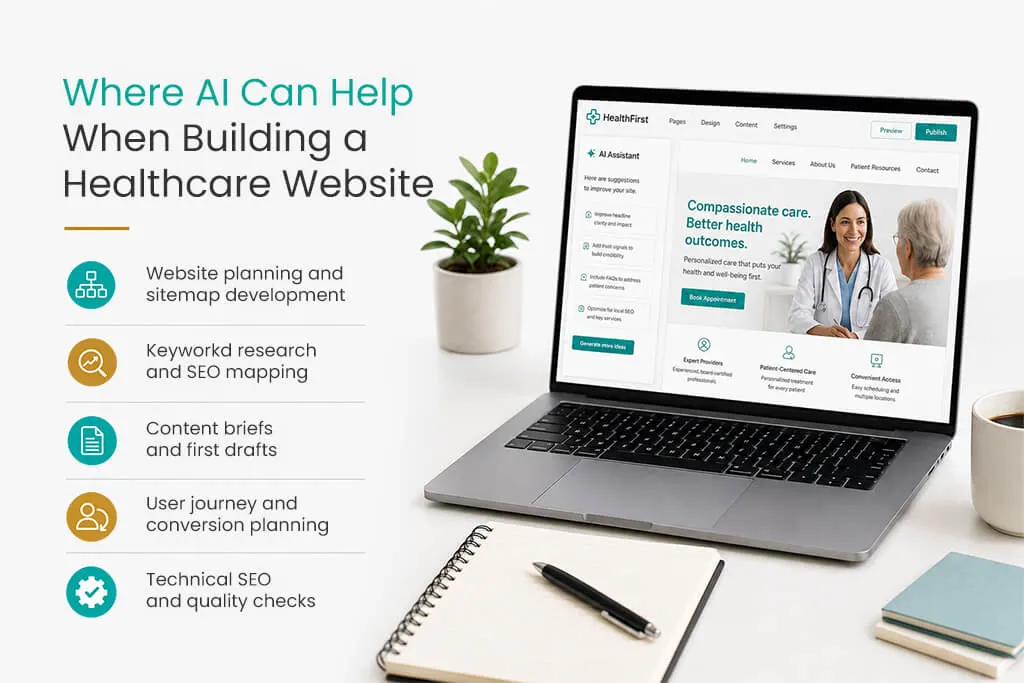
AI can be incredibly useful during the early stages of a healthcare website project, especially when teams need to organise ideas, validate structure and create momentum.
Here’s where AI can add real value.
1. Website planning and sitemap development
Before design begins, every website needs a clear structure. AI can help generate sitemap options based on audience type, service lines, product categories, geographies and search intent.
For example, a MedTech company may need pages for healthcare professionals, procurement teams, distributors and investors. A clinic may need service pages, condition pages, practitioner profiles, location pages and patient FAQs.
AI can help create the first draft of that structure. But the final sitemap still needs to be reviewed by people who understand the business model, customer journey and healthcare environment.
2. Keyword research and SEO mapping
AI can support keyword brainstorming, topic clustering and content mapping. It can help identify the difference between broad awareness searches and higher-intent searches.
In healthcare SEO, this matters.
Someone searching “what is remote patient monitoring” is likely at a different stage of the journey than someone searching “remote patient monitoring platform for hospitals.” Your website needs to speak to both, but not in the same way.
AI can help organise these opportunities, but it should be paired with real search data, competitor analysis and healthcare-specific SEO expertise.
3. Content briefs and first drafts
AI can help create content briefs for service pages, product pages, blog posts, FAQs and landing pages. It can also generate first-draft copy to speed up the writing process.
This is helpful when you are trying to build a large website or refresh outdated content.
However, AI-generated healthcare content should never be published without expert review. It needs to be checked for accuracy, audience fit, claims, tone, compliance and originality.
In healthcare, a technically correct sentence can still be commercially weak, clinically vague or inappropriate for the market.
4. User journey and conversion planning
Healthcare websites need to guide users clearly.
A patient may need reassurance and simple next steps. A clinician may need clinical evidence, product specifications or referral information. A procurement team may need proof of value, implementation detail and risk reduction. An investor may need market positioning and commercial traction.
AI can help map these journeys and suggest calls-to-action for each audience. But the strongest websites are built from real customer insight, sales team feedback, market understanding and clinical context.
5. Technical SEO and quality checks
AI tools can support technical reviews by helping identify issues such as missing metadata, duplicate titles, thin content, unclear headings, broken internal links or accessibility gaps.
This can make the website build more efficient.
But AI does not replace a proper technical SEO process. Site speed, crawlability, indexation, schema, mobile responsiveness and internal linking still need to be checked properly before and after launch.
Where AI needs human oversight
AI can support healthcare website development, but there are areas where human review is essential.
Medical and clinical accuracy
AI can sound confident even when it is wrong. This is a risk in any industry, but it is especially important in healthcare.
Any content that references conditions, treatments, products, indications, contraindications, risks, benefits, clinical evidence or patient outcomes needs to be checked by qualified people.
Accuracy builds trust. Inaccuracy damages it quickly.
Regulatory and compliance requirements
Healthcare advertising and promotional rules vary by market, audience and product type. What is acceptable in one country may not be acceptable in another.
AI does not reliably understand the full regulatory environment for your specific business, product, indication or geography. Claims still need to be reviewed carefully.
This is particularly important for pharmaceutical, medical device, medical cannabis and professional-only healthcare communications.
Brand voice and differentiation
If every company uses the same AI tools to write the same type of content, websites start to sound the same.
Your differentiator is not the fact that you used AI. Your differentiator is your clinical understanding, commercial strategy, product expertise, customer insight and brand position.
AI can help organise the message. It cannot replace the thinking behind it.
Patient trust
Patients and carers often visit healthcare websites during stressful, emotional or uncertain moments. The language needs to be clear, respectful and easy to understand.
AI-generated copy can sometimes sound polished but impersonal. Human review helps ensure the content is appropriate, empathetic and useful.
A Practical Workflow for Using AI Responsibly
AI works best when it is built into a clear website process.
Here’s a practical approach for healthcare organisations:
- Start with strategy: Define the audience, business goals, market, offer and website role.
- Map the customer journey: Understand what each user needs before they convert.
- Complete keyword research: Use search data to understand what people are actually looking for.
- Build the sitemap: Structure the website around services, products, industries, locations and audience needs.
- Use AI for support: Generate outlines, content briefs, FAQ ideas and first-draft copy.
- Review with healthcare expertise: Check accuracy, claims, compliance and audience fit.
- Optimise for SEO: Refine headings, metadata, internal links, schema and content structure.
- Test the user experience: Make sure the site is clear, accessible, fast and easy to navigate.
- Measure after launch: Track rankings, traffic, engagement, leads and conversion quality.
AI can accelerate many of these steps, but it should not remove the strategic thinking that makes the website effective.
AI and healthcare SEO
AI is also changing the way search works.
Search engines are becoming better at understanding context, intent and natural language. This means healthcare websites need to do more than repeat keywords. They need to answer real questions with clarity, authority and depth.
For healthcare brands, this is a major opportunity.
Strong SEO content can help you reach patients, clinicians, procurement teams and decision-makers when they are actively searching for information. But the content needs to be structured properly, technically sound and aligned with the customer journey.
AI can help with research, content planning and optimisation. But sustainable SEO still depends on:
- Clear website architecture
- High-quality healthcare content
- Technical performance
- Strong internal linking
- Search intent alignment
- Evidence-led messaging
- Ongoing content improvement
- Authority and trust
SEO is not a one-and-done task. It evolves as your market, products, competitors and customers change.
Questions to ask before using AI on your healthcare website
Before using AI to build or rewrite your healthcare website, ask:
- Who is the website for?
- What decisions does the website need to support?
- Which pages require clinical, regulatory or compliance review?
- What content can AI safely assist with?
- What content must be written or reviewed by a subject matter expert?
- Are our claims accurate and substantiated?
- Does the content reflect our actual brand voice?
- Is the website structured for SEO and user experience?
- How will we measure success after launch?
If these questions are not answered upfront, AI can create more work later.
So, should you use AI when building a healthcare website?
Yes, but strategically.
AI can be a powerful tool for planning, research, content development and optimisation. It can help healthcare organisations move faster and make the website build more efficient.
But AI should not replace healthcare expertise, regulatory awareness, commercial strategy or human judgement.
The best healthcare websites will not be the ones that use AI the most. They will be the ones that use AI wisely, with the right strategy, review process and healthcare knowledge behind it.
Want to build a smarter healthcare website? Here’s how we can help
You’ve got the ambition. We’ve got the healthcare website playbook.
We build high-performance healthcare websites designed for visibility, credibility and growth. Our team combines healthcare industry experience, SEO strategy, content creation, design, project management and digital marketing delivery.
We understand the difference between a website that simply looks good and a website that supports commercial outcomes.
Here’s how we can help:
- Website Strategy: Define the right structure, audience journey and conversion pathway.
- Healthcare SEO: Build your website around search visibility and customer intent.
- Content Planning & Copywriting: Create content that speaks the language of your audience.
- Website Design & Development: Build a professional, accessible and high-performing digital presence.
- Healthcare-Experienced Review: Ensure your messaging is accurate, credible and aligned with your market.
- Ongoing Optimisation: Continue improving visibility, engagement and conversion after launch.
AI can help speed up the process. Healthcare expertise makes sure the outcome is right.
Performance: why speed matters in healthcare website design
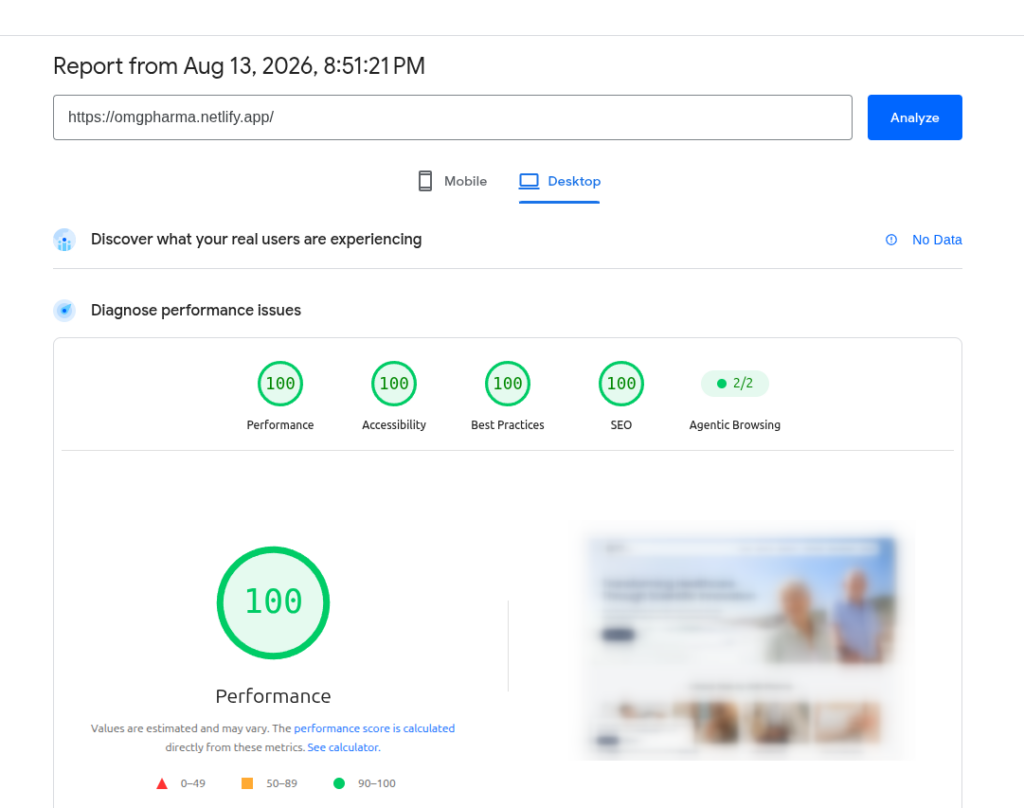
A fast website directly impacts user experience, search visibility and conversion. In healthcare, where users may be looking for important information quickly, slow load times can create frustration and reduce trust before your content has the chance to do its job.
Performance should be considered from the start. Lightweight frameworks like Astro can help deliver fast-loading pages, clean code and strong Core Web Vitals, creating a better experience for patients, clinicians, procurement teams and decision-makers.

Ready to build a healthcare website that works harder for your business? Contact us today.
Frequently Asked Questions
Can AI be used to build healthcare websites?
Yes, AI can be used to support healthcare website planning, content development, SEO research, sitemap creation and quality checks. However, it should be used as a support tool, not as a replacement for healthcare expertise, regulatory review or strategic thinking.
Is AI-generated healthcare content safe to publish?
AI-generated healthcare content should not be published without human review. Any content involving medical conditions, treatments, products, claims, risks, benefits or patient outcomes should be checked by qualified experts to ensure accuracy, compliance and trust.
Where can AI help most during a healthcare website project?
AI is particularly useful in the early stages of a website build. It can help organise ideas, create sitemap options, draft content briefs, suggest FAQs, support keyword research and map user journeys for patients, clinicians, procurement teams or investors.
What are the risks of using AI for healthcare website copy?
The main risks include inaccurate information, generic messaging, unsupported claims, compliance issues and content that does not reflect the organisation’s real brand voice. In healthcare, even small wording issues can affect trust and credibility.
Does AI replace healthcare SEO expertise?
No. AI can support keyword brainstorming, topic clustering and content planning, but sustainable healthcare SEO still requires real search data, technical SEO checks, competitor analysis, content strategy, internal linking and ongoing optimisation.
Should every healthcare business use AI when building a website?
AI can be valuable for many healthcare organisations, but only when used strategically. The strongest websites are not the ones that use AI the most. They are the ones that use AI wisely, with the right expertise, review process and commercial strategy behind it.