

In healthcare, marketing is never just about getting attention.
You are often communicating with clinicians, patients, procurement teams, investors, distributors, executives, regulatory stakeholders and internal sales teams. Each audience has different needs, different levels of knowledge and different reasons to trust or question your solution.
That’s why healthtech marketing strategy needs to go deeper than campaigns, social posts or a polished website.
A strong strategy connects your commercial goals, customer journey, positioning, messaging, channels and sales process. It helps the right people understand your value, trust your expertise and take the next step.
Without that strategy, even great tactics can underperform.
Why a healthtech marketing strategy requires a different approach.
Healthtech companies operate in complex markets.
Buying journeys are often long. Decision-making involves multiple stakeholders. Claims need to be accurate. Messaging needs to balance innovation with credibility. And in many cases, your audience needs education before they are ready to act.
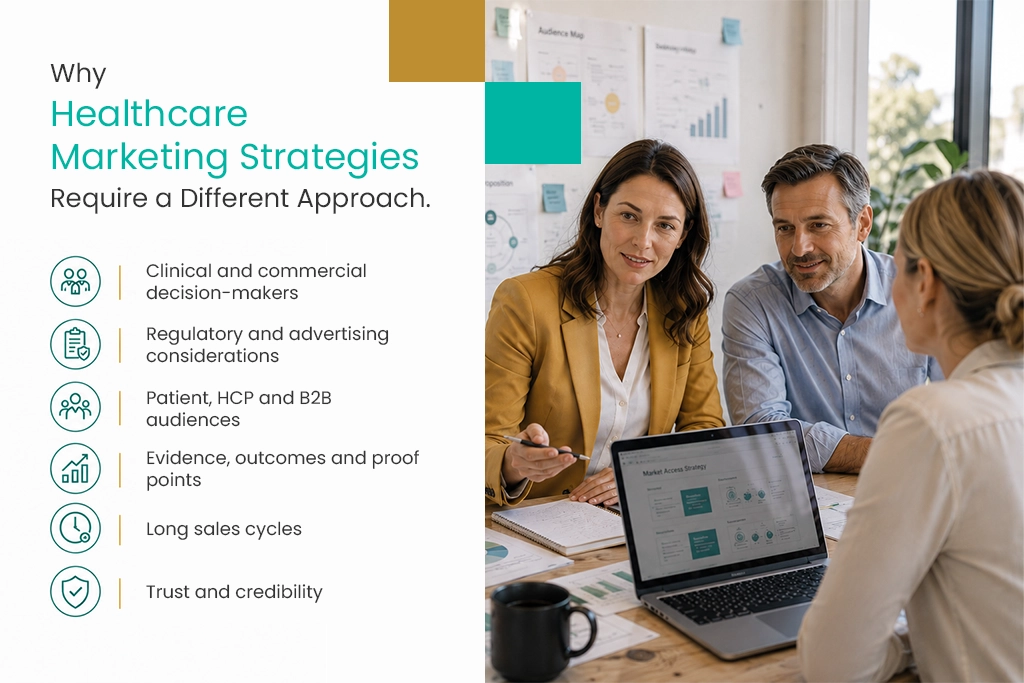
A healthtech marketing strategy needs to account for:
- Clinical and commercial decision-makers
- Regulatory and advertising considerations
- Patient, HCP and B2B audiences
- Evidence, outcomes and proof points
- Long sales cycles
- Market access and adoption barriers
- Product complexity
- Sales team enablement
- Trust and credibility
This is why a generic marketing approach rarely works.
Healthcare buyers are not just looking for a product or service. They are looking for confidence. They want to know the solution is credible, relevant, evidence-led and worth the operational, clinical or financial change required.
Start with the commercial goal
Before choosing channels or creating content, define what the business actually needs to achieve.
Is the goal to:
- Launch a new product?
- Generate qualified leads?
- Build awareness in a new market?
- Support distributor conversations?
- Educate clinicians?
- Drive patient enquiries?
- Improve sales team confidence?
- Reposition the brand?
- Build investor credibility?
Each goal requires a different strategy.
A campaign designed to build awareness will look very different from a strategy designed to support procurement conversion. A website built for patients will not have the same structure as one built for hospital decision-makers.
Clear commercial goals help marketing stay focused and measurable.
Understand who you need to influence
In healthtech, your buyer is rarely one person.
A medical device company may need to influence surgeons, nurses, hospital executives, procurement teams and distributors. A digital health company may need to speak to clinicians, patients, payers and investors. A healthcare service provider may need to reach patients, referrers and internal stakeholders.
Each audience needs a different message.
The strategy should define:
- Who the primary audience is
- Who influences the decision
- What each audience cares about
- What objections they may have
- What proof they need
- What action you want them to take
This is where many healthcare marketing plans fall short. They try to speak to everyone in the same way.
The stronger approach is to map your audiences clearly and build messaging that meets each group where they are.
Map the healthcare buying journey
Healthcare decisions take time.
Your audience may move through awareness, education, comparison, internal discussion, approval and implementation before they are ready to commit.
A strong healthtech marketing strategy maps this journey and identifies what content, messaging and channels are needed at each stage.
For example:
- Awareness: educational blogs, SEO content, social posts, PR and thought leadership
- Consideration: case studies, product pages, comparison guides, webinars and explainer content
- Decision: sales decks, clinical evidence, ROI messaging, implementation detail and consultation pathways
- Adoption: onboarding materials, training content, internal communications and sales enablement
Marketing should not stop once someone becomes aware of your brand. In healthcare, some of the most important marketing work happens after that first touchpoint.
Clarify your positioning and messaging
Your positioning is the foundation of your marketing strategy.
It should clearly answer:
- What do you do?
- Who do you help?
- What problem do you solve?
- Why does it matter?
- Why should your audience trust you?
- How are you different from alternatives?
Healthtech companies often struggle here because their products or services are complex. The messaging becomes too technical, too broad or too internally focused.
Good healthcare messaging makes complexity easier to understand without oversimplifying the value.
It should connect clinical, commercial and human outcomes. It should also reflect the reality of the market, not just the internal view of the product.
Choose channels based on intent
A healthtech company doesn’t need to be everywhere.
The right channels depend on your audience, market, product stage and commercial goal.
For some companies, SEO and a strong website will be the priority because buyers are actively searching for solutions. For others, LinkedIn, webinars, conferences, paid campaigns or sales enablement may play a bigger role.
Common channels include:
- Website and SEO
- Paid search
- Paid social
- Email marketing
- Webinars
- Events and conferences
- Sales enablement materials
- PR and thought leadership
- Distributor or partner marketing
The key is to choose channels based on where your audience is and what they need at each stage of the journey.
A channel is only useful if it supports the strategy.
Build trust through evidence and education
Trust is one of the most important assets in healthcare marketing.
Your audience needs to believe that you understand their world, their challenges and the impact of your solution.
That trust can be built through:
- Educational content
- Clinical or technical proof points
- Case studies
- Clear product information
- Thought leadership
- Consistent messaging
- Professional website design
- Search visibility
- Relevant testimonials or outcomes
- Sales materials that answer real objections
This is especially important for innovative healthtech companies. If your solution is new, your audience may need help understanding not only what it does, but why it matters and how it fits into their current workflow.
Education is not a “nice to have”. It is often what moves people from interest to adoption.
Align marketing with sales, product and regulatory teams
Healthcare marketing works best when it is not created in isolation.
Sales teams understand the questions, objections and buying signals they hear every day. Product teams understand the technical value and development roadmap. Regulatory and quality teams understand what can and cannot be said. Leadership understands the commercial priorities.
A strong marketing strategy brings these perspectives together.
This helps ensure your campaigns, website, content and sales materials are accurate, useful and commercially relevant.
It also reduces the risk of creating marketing that looks good but does not help the business move forward.
Measure what matters
Marketing measurement should connect back to the commercial goal.
Website traffic and social engagement can be useful, but they are not the whole story. In healthcare, quality matters more than volume.
Useful metrics include:
- Organic visibility for priority search terms
- Qualified enquiries
- Consultation bookings
- Sales conversations influenced by marketing
- Content engagement from target audiences
- Conversion rates by page or campaign
- Cost per qualified lead
- Pipeline contribution
- Event or webinar follow-up quality
- Sales team usage of marketing materials
The right metrics help you understand what is working, what needs refinement and where to invest next.
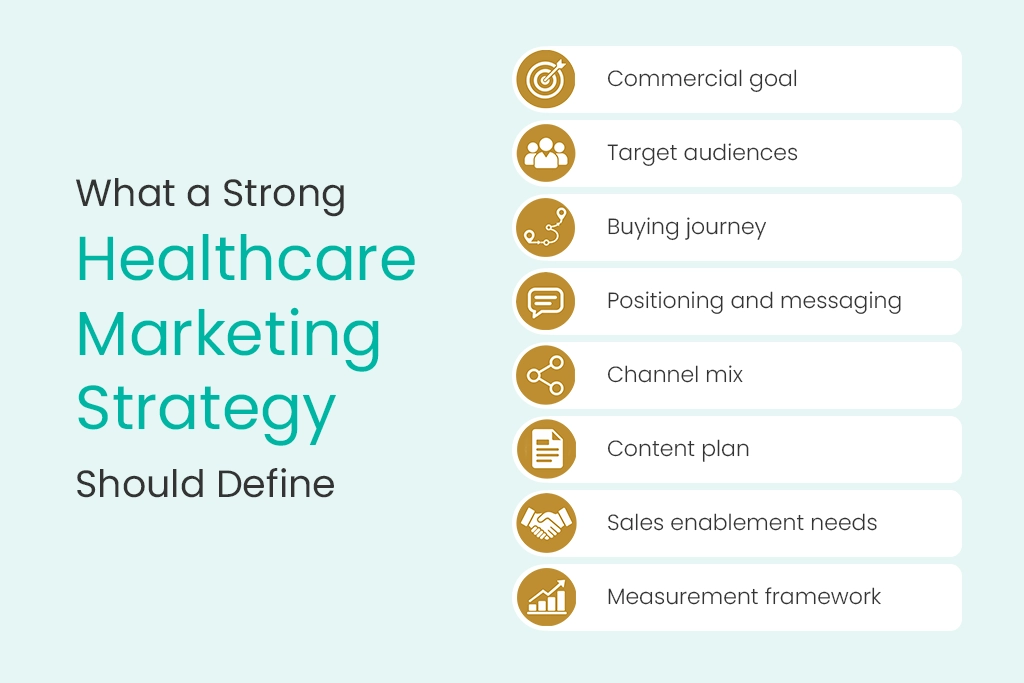
So, what makes a strong healthtech marketing strategy?
A strong healthtech marketing strategy is clear, focused and connected to the business.
It should define:
- The commercial goal
- The target audiences
- The buying journey
- The positioning
- The messaging
- The channel mix
- The content plan
- The sales enablement needs
- The measurement framework
Most importantly, it should be practical.
The strategy should not sit in a document that never gets used. It should guide decisions, prioritise activity and help the team execute with confidence.
Want to build a healthtech marketing strategy that drives growth?
You’ve got the ambition. We’ve got the healthcare marketing playbook.
At Healthtech Marketing Solutions, we help healthcare, MedTech, pharmaceutical, medical cannabis and health and wellness companies build marketing strategies that are grounded in industry experience and designed for growth.
We understand the complexity of healthcare markets because healthcare marketing is all we do.
Here’s how we can help:
- Strategic Marketing Planning: define the right goals, audiences, messaging and priorities.
- Positioning & Messaging: clarify your value proposition and communicate it with confidence.
- Website & SEO Strategy: build digital foundations that support visibility and conversion.
- Content Planning: create educational, evidence-led content for the right audiences.
- Digital Marketing: execute campaigns across the channels that matter most.
- Sales Enablement: give your sales team the tools and messaging they need to convert.
- Launch Support: bring new products, services or markets to life with a clear plan.
A strong strategy gives every tactic a purpose.
Let’s make sure your marketing is working as hard as your innovation.

Ready to build a smarter healthcare marketing strategy? Contact us today.